When people hear "AI localization," they often imagine the worst possible workflow.
A script is fed into a machine one line at a time. The machine produces flat, literal English. A team of poorly paid translators then spends days correcting awkward dialogue, missing context, and broken character voices.
That is not a bold use of generative AI.
It is an old machine translation workflow with a newer engine.
The current debate around Japan's reported ¥11.5 billion (roughly US$70 million) subsidy program — first revealed by The Yomiuri Shimbun and widely covered across global media like Polygon and Kotaku — for overseas expansion of anime, manga, games, and other entertainment appears to be trapped inside this old mental model.
Supporters see AI as a way to release official versions faster and compete with piracy. Critics expect rushed, low-quality localization that fans will immediately reject.
Both sides are assuming that AI localization means asking a machine to translate every line.
It does not have to mean that.
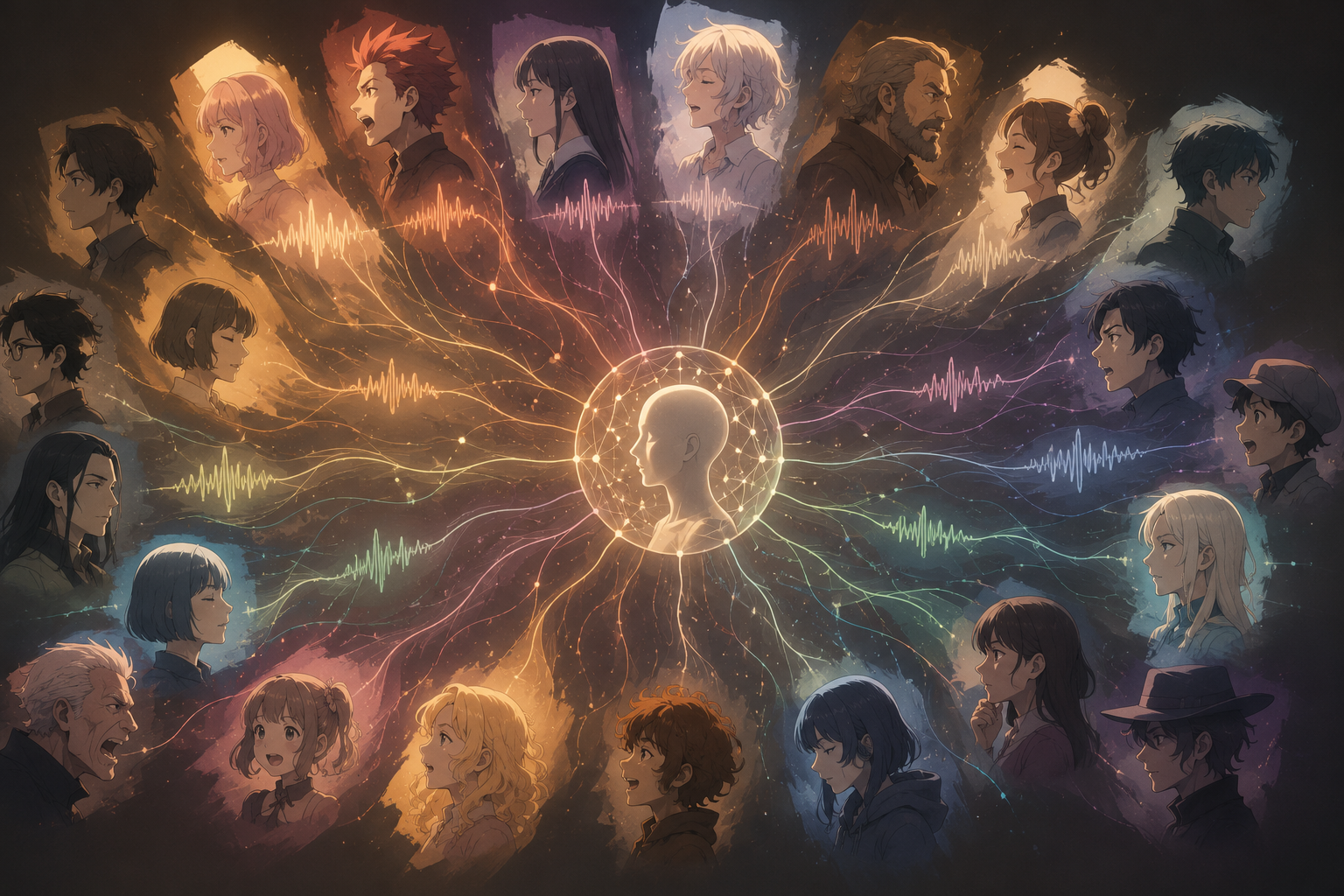
Generative AI creates a different possibility: an AI that has read the entire story, understands the relationships between its characters, remembers how they spoke fifty episodes ago, and can perform each role in a distinct voice.
The future of anime localization may not be a translation machine.
It may be an AI with a thousand voices.
"AI translation is low quality" is not a fact
It is a workflow assumption.
Most examples of poor AI localization tell us very little about the quality ceiling of generative AI. They tell us that someone used the model badly.
A general-purpose language model is not limited to replacing Japanese sentences with English sentences.
It can analyze plot, character motivation, social hierarchy, emotional development, recurring jokes, narrative function, and the linguistic patterns that distinguish one speaker from another.
It can learn that one character never expresses reassurance directly.
It can recognize that another becomes more formal when afraid.
It can distinguish how someone speaks to a rival, a parent, a subordinate, or a close friend.
It can preserve a verbal habit across hundreds of episodes.
A fragmented human production workflow often struggles to do this. Translators work under tight deadlines. Episodes may be divided among multiple people. Reference materials are incomplete. Decisions made in one season may not be visible to the team working on the next.
Even an excellent translator cannot hold every previous line, relationship, plot detail, and character arc in active memory at all times.
An AI system can.
That does not mean quality appears automatically.
It means quality can be designed into the system before generation begins.
Build the character before generating the dialogue
The most important human role in this model is not the post-editor.
It is the Character Architect.
The Character Architect does not spend months correcting thousands of machine-generated lines. Their expertise is concentrated where it has the greatest leverage: defining the character before the AI begins performing the role.
They first identify the Golden Episodes.
These are not simply the first three episodes in a series. They are the episodes and scenes that reveal the widest possible range of each important character's voice.
A useful selection might include:
- ordinary conversation
- conflict with a rival
- intimacy with a trusted companion
- fear disguised as anger
- comedy
- defeat
- authority
- emotional vulnerability
- a major turning point in the character arc
The Character Architect then produces publication-quality English for the most revealing dialogue.
But the translation itself is only part of the deliverable.
The reasoning behind it must also be documented.
Why is this line short?
Why does the character avoid explicit reassurance?
Why is the aggression expressed through syntax rather than profanity?
Why should a recurring phrase remain stable in one context but change in another?
What would this character never say?
The result is a Character Language Profile.
The Character Language Profile
A Character Language Profile is not a conventional glossary or style guide.
It is a model of how the character exists in language.
It may document:
Core personality
What drives the character? What do they hide? How do they react under pressure?
Relationship-specific speech
How does the character speak to friends, enemies, elders, strangers, children, or authority figures?
Voice mechanics
Sentence length, vocabulary level, contractions, slang, rhythm, directness, humor, profanity, repetition, and rhetorical habits.
Emotional variation
How does the voice change during fear, rage, affection, embarrassment, grief, or victory?
Narrative development
Does the character's language change over time? Do they become more restrained, more confident, more intimate, or more formal?
Translation boundaries
Which expressions are prohibited? Which cultural elements should not be over-adapted? Which lines require consistency across the work?
Golden dialogue examples
Source context, finished English, and an explanation of why the localized line works.
Each example should capture not only what the character says, but the dramatic function of the line.
For example:
Source intent
The character is protecting a frightened companion but does not express tenderness directly.
Weak literal version
"Don't worry. Everything will be all right."
Character-faithful version
"Quit shaking. We're not done yet."
Rationale
The character does not verbalize comfort. Protection is expressed through an imperative and the inclusive "we." Soft reassurance would weaken the established voice.
This is not correction data.
It is linguistic direction.
Together, the profiles, examples, constraints, and rationales form the character's linguistic DNA.
The AI becomes the actor
Once that linguistic DNA exists, the AI can generate the remaining dialogue under controlled conditions.
It is no longer being asked:
"How do I translate this sentence?"
It is being asked:
Who is speaking?
What do they know at this point in the story?
Who are they speaking to?
What are they trying not to reveal?
What emotion are they suppressing?
How would this character produce the same dramatic effect in English?
The AI can then inhabit a different linguistic persona for every character.
One model may perform hundreds of roles, but it should not sound like one generic machine. Each role is governed by its own profile, examples, relationships, and constraints.
This is where generative AI may reach a level of consistency that traditional high-volume workflows rarely achieve.
The same character model could be applied across subtitles, dubbing scripts, game dialogue, promotional material, social posts, sequels, and related media.
The expensive creative work happens upfront.
The marginal cost of generating additional material falls dramatically.
That does not reduce the value of the Character Architect.
It increases it.
Their decisions can shape an entire franchise rather than a limited batch of lines.
This is not MTPE
Machine translation post-editing begins with defective text and asks humans to repair it.
A generation-native workflow begins with human intent and asks AI to perform within a designed system.
The distinction matters.
The human should not remain at the end of the production line, correcting the same class of mistake hundreds of times.
Mechanical checks can be automated:
- terminology consistency
- character knowledge at a given point in the plot
- chronology
- recurring lines
- prohibited expressions
- subtitle length and reading speed
- names, titles, and relationship markers
- deviation from the Character Language Profile
Human judgment should be reserved for questions that cannot be reduced to error detection.
Does the character feel alive?
Does the English produce the intended emotional effect?
Has the adaptation preserved the relationship between the characters?
Does the performance belong in this scene?
The final human is not an error-checker.
They are a director.
They read or watch the work as a whole and judge the performance.
From anonymous translator to Character Architect
This future will not preserve translation employment at its current scale.
A large amount of line-by-line production work may disappear.
Perhaps, metaphorically, 990 translators out of 1,000 lose the old kind of assignment.
But the remaining ten may gain something translators have rarely had: authorship, visibility, and individual credit.
Traditional localization often hides skilled people inside vendor chains. Fans may love the English version of a character without knowing who created that voice. A translator can make thousands of excellent decisions and remain invisible.
A Character Architect would be different.
Their name could appear in the credits.
Fans could recognize their work.
Studios and platforms could request them directly.
A viewer might say:
"This person designed the English voice of that character. I want them on the next series."
The strongest localization professionals would no longer be valued for the number of lines they can process.
They would be valued for their ability to identify the few examples and principles that allow a system to reproduce excellence at scale.
The best translator may be hired to translate only a handful of episodes.
Those episodes could determine the voice of the next five hundred.
The real opportunity
The debate should not be limited to whether AI can make localization faster.
It can.
The more interesting question is whether AI can produce forms of quality that fragmented human workflows have struggled to sustain.
Can one character remain recognizably themselves across hundreds of episodes?
Can every relationship have its own linguistic texture?
Can past dialogue, plot knowledge, emotional development, and character constraints remain active throughout the production process?
Can the best judgment of one exceptional language professional be amplified across an entire body of work?
Generative AI makes all of this possible.
But only when it is treated as a performer, not a dictionary.
The future of AI localization is not one machine translating a thousand characters in the same voice.
It is one AI capable of a thousand voices, each designed by someone who understands exactly who that character is.
Beyond anime
This essay describes one application of a generation-native localization workflow.
At IC Eight, this approach sits within our AI-Native Localization Framework. We call the underlying method Intent-Based Generation, operationalized through the Four-Layer Workflow.
The same principle applies beyond anime: define intent, voice, context, and constraints before generation begins, rather than translating first and repairing the output later.
Whether the domain is character dialogue or SaaS product UX, the quality of the result depends on what the system has been designed to understand and achieve.
The AI with a thousand voices
Translation asks how to move words from one language to another.
This approach asks something different: who is speaking, what they know, and what they are trying not to reveal.
That question does not belong to anime alone. It belongs anywhere a system must carry intent, identity, and voice across languages.