Most localization workflows have the same structure: take the English source, produce a target language version, have a human fix what doesn't work.
The tool may be AI now. The assumption hasn't changed.
IC Eight works differently. Not because the tools are different — but because the starting point is different.
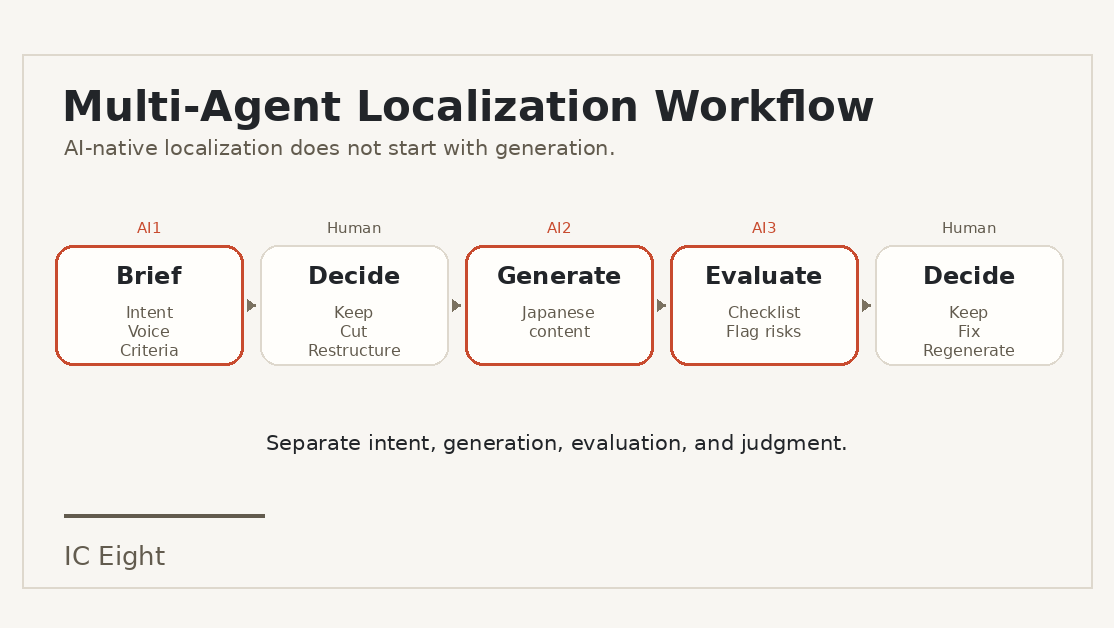
Layer 1 — Briefing Agent (AI1)
The first AI reads the source content and produces an intent brief. Not a translation brief. A brief that answers:
What is this content for? What voice should the Japanese use? What are the success criteria — what does this content need to achieve? What expressions, tones, or assumptions should be avoided?
Depending on the content, the brief also clarifies the role of each section and what information must be preserved.
Human decision point
Before anything is generated, a human reviews the intent brief and makes content decisions.
Is this section necessary in Japanese? Should it be cut, shortened, or restructured? Does the brief reflect how Japanese users actually think — or is it carrying over assumptions that don't travel?
This is not editing. This is deciding what gets built.
Layer 2 — Generation Agent (AI2)
The second AI generates Japanese content based on the confirmed intent brief. It does not translate the source sentence by sentence. It generates from intent and voice direction — producing output that functions in Japanese, not output that corresponds to English.
Layer 3 — Evaluation Agent (AI3)
The third AI receives the source, the confirmed intent brief, the review criteria, the voice direction, the avoid list, and the AI2 output.
Its job is not to check whether the output matches the source. Its job is to verify whether the intent, essential information, tone, trust signals, and user actions are intact.
The output is not a pass/fail score. It is a checklist with flagged risks — specific, actionable, and focused on what actually matters.
Decision layer — Human judgment
The human reviews AI3's checklist and makes the final call. Not line by line. Focused on what AI3 flagged.
For each item: keep it, fix it, cut it, or send it back for regeneration.
This is where human judgment belongs — at the decisions that matter, not at every sentence.
Why this works
Multi-agent workflows are becoming a common way to make AI systems more reliable: separate the roles, define the inputs, and let each agent do one job.
IC Eight applies that structure to localization.
Most AI localization workflows still begin at the generation step: give AI the source content and ask it to produce Japanese. IC Eight's multi-agent workflow starts earlier. It separates intent definition, content decisions, generation, evaluation, and final human judgment.
That separation matters. It prevents the generation step from becoming uncontrolled rewriting. It prevents the evaluation step from falling back into sentence-by-sentence translation review. And it gives the human reviewer a clear basis for deciding what to keep, fix, cut, or regenerate.
The point is not to use multiple AI agents because it sounds advanced. The point is to make AI-generated localization controllable.