Recently I saw people using prompts that turn X profile screenshots into magazine covers. The results were fun, but what caught my attention was not the fashion-magazine style itself. It was the method.
A good magazine-cover prompt works because it does not try to preserve the original profile text. It reads the intended persona and regenerates it for a new audience, in a new medium. It looks at the profile and asks, implicitly: Who is this person trying to be in public? What kind of audience are they speaking to? What impression should the cover create? What would this become if it were not a profile, but an editorial product?
That is why the output works. The AI is not copying the bio into a prettier layout. It is extracting intent, audience, tone, positioning, and visual language, then rebuilding the content as a magazine cover.
That is the same move localization needs to make.
In localization, preserving the source copy is still often treated as quality. But users never see the source copy. They only see whether the product makes sense to them, whether they trust it, and whether they know what to do next.
So I tried the same idea with IC Eight.
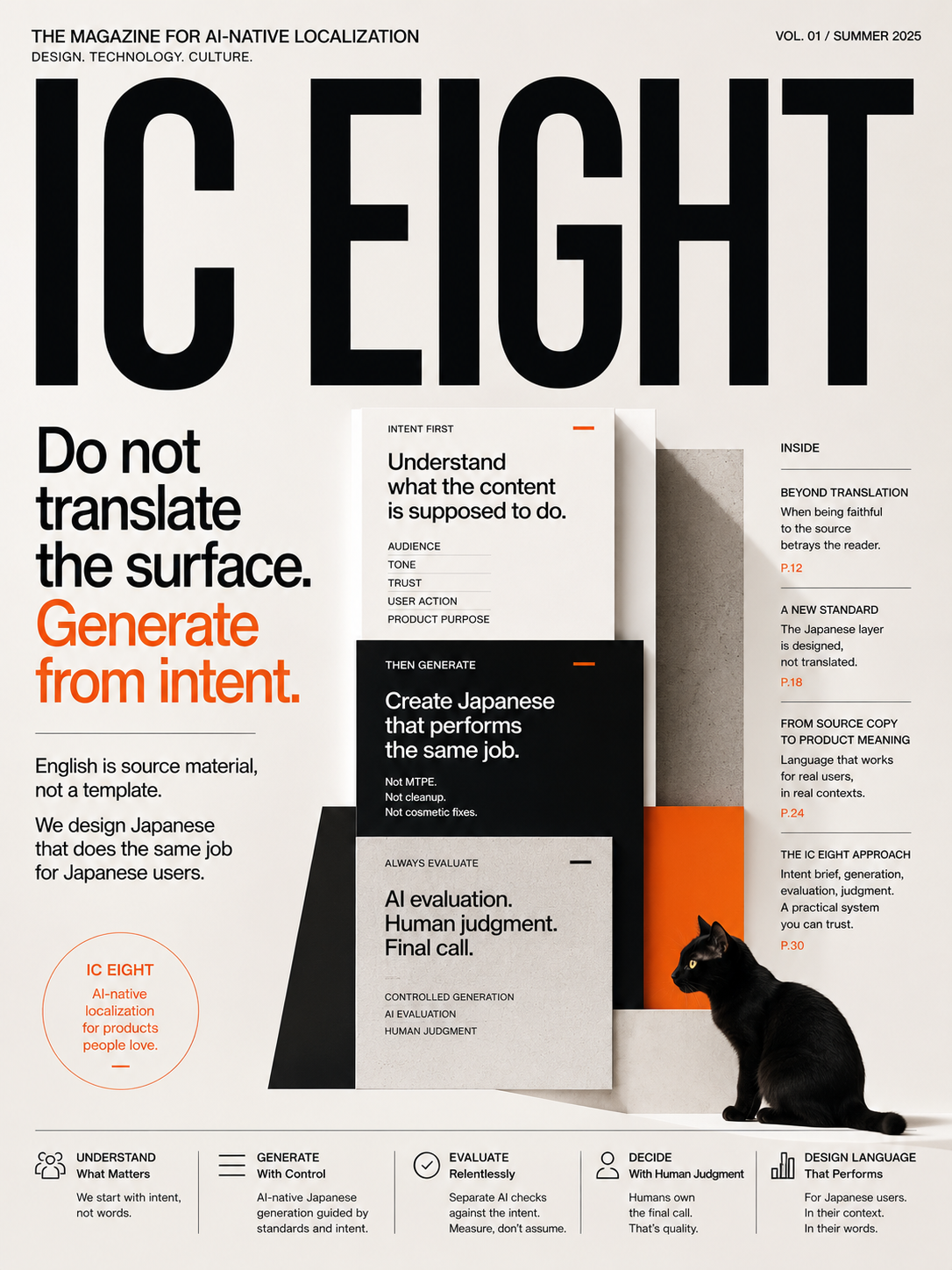
Not as a fashion magazine, but as an editorial cover for product language, AI-native localization, and design intelligence. The input was not "translate this website." It was a brief: audience, medium, point of view, and the job the content needed to perform.
The result was not a visual translation of my site. It was a different expression of the same system: English source copy as material, intent first, controlled generation, AI evaluation, and human judgment.
That is the shift I think localization needs.
A translation workflow asks, "How do we say this in Japanese?" An intent-driven localization workflow asks, "What is this supposed to do for the user, and how should Japanese express that job?"
The difference is not cosmetic. It changes the output.
Translation preserves the source. Intent-driven localization preserves the job the content is supposed to do.